
Play Le King Now!
Home → Symbols & Payouts
Le King Symbols
Symbol set of Le King
The reel layout of Le King features a 6x5 grid where symbols align for cluster pays rather than fixed paylines, creating a dynamic structure for potential wins. This configuration allows any adjacent group of matching icons to trigger a payout, distinguishing it from traditional line-based games like Le Cowboy which also uses a 6x5 format but relies on different mechanics. Players must understand that adjacency matters more than position, requiring attention to the central area of the screen for frequent interactions. Consequently, the visual density of the grid directly impacts the frequency of cascading events and subsequent symbol replacements.
Le King paytable and grid
| Grid | 6x5 |
| Paylines / ways | Cluster pays, no fixed lines |
| Bonus trigger | 3, 4 or 5 scatters trigger one of three bonuses |
Hacksaw Gaming designed this slot with an Elvis-inspired raccoon theme, populating the reels with thematic icons that drive the core gameplay loop. The studio released Le King in 2025, ensuring modern graphics that support the medium volatility setting and its 41.33% hit frequency. This high hit rate means players will see winning combinations regularly, even if individual payouts are modest compared to max win scenarios. Therefore, the thematic presentation serves as a consistent backdrop for the mechanical action, keeping the player engaged during standard spins without relying solely on rare bonus triggers.
The maximum win cap for Le King stands at 20000x the total bet, offering significant upside potential despite the medium volatility classification. This theoretical limit is achieved through cascading wins and special features, contrasting with titles like Le Cowboy which offers a 25000x cap but maintains similar volatility parameters. Understanding this ceiling helps players manage expectations regarding long-term returns versus short-term variance during a session. As a result, bankroll management becomes essential when chasing these higher multipliers, as the path to 20000x requires sustained play and favorable cluster formations.
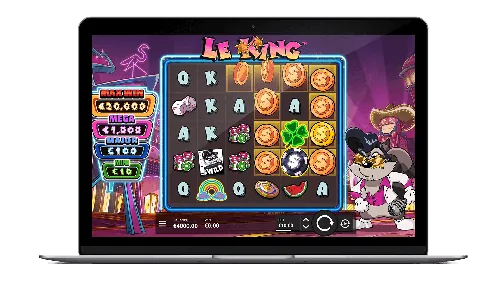
High-paying symbols
The high-paying symbols in Le King are primarily represented by the Elvis-inspired raccoon character, known as Smokey, which acts as a key driver for larger cluster payouts. This character substitutes for other regular symbols to help form winning clusters, effectively increasing the probability of achieving higher value combinations on any given spin. Unlike scatter symbols that pay independently, Smokey must be part of a connected group to contribute to the win calculation, integrating seamlessly into the cascade mechanic. Players should prioritize forming clusters around this character to maximize the return on each base game interaction within the 6x5 grid.
Cluster pays mechanics mean that high-value icons do not need to align on specific lines, allowing for flexible winning patterns across the 6x5 reel layout. A single spin can generate multiple wins if cascading wins occur, where winning symbols disappear and new ones fall into place, potentially creating additional high-paying clusters. This process continues until no new winning combinations appear, extending the duration of a single spin event and increasing the total payout potential significantly. Consequently, the effective value of high-paying symbols is amplified by the cascade feature, making them more valuable than their static face value suggests.
The theoretical return of 96.14% for Le King is heavily influenced by the frequency and size of these high-paying symbol clusters over millions of spins. While the RTP indicates long-term performance, the actual outcome of a session depends on hitting these clusters consistently during the medium volatility phase. Operators may offer lower RTP configurations such as 94.18%, 92.25%, or 88.25%, which reduce the expected return from these high-value interactions. Therefore, verifying the specific RTP version available at the casino is crucial for understanding the true mathematical expectation of playing the high-paying symbols in this Hacksaw Gaming title.
Low-paying symbols
Low-paying symbols in Le King consist of standard card ranks or thematic icons that form the bulk of the visible reel content and facilitate frequent small wins. These symbols are essential for maintaining the 41.33% hit frequency, as they appear often enough to keep the reel positions active and trigger minor cascades throughout the gameplay. Their presence ensures that even without high-value clusters, players experience regular feedback from the machine, which is critical for sustaining engagement during medium volatility sessions. This steady stream of small outcomes contrasts with the occasional large payouts driven by the high-paying Smokey character.
The bet range for Le King starts at 0.10, meaning low-paying symbol wins can still provide a meaningful return relative to the minimum stake level. Each winning cluster of low symbols contributes to the overall turnover, though the multiplier applied is significantly smaller than that of the high-paying icons. In comparison to Le Cowboy, which shares a similar 6x5 layout, the impact of low symbols in Le King is defined by their role in enabling cascades rather than standalone big wins. Players betting at the lower end of the scale rely on these frequent, smaller hits to preserve their bankroll during extended play sessions.
Understanding the contribution of low-paying symbols helps players appreciate the overall volatility profile of this Hacksaw Gaming release, which balances risk with reward. While these symbols rarely trigger the maximum win cap of 20000x, they are instrumental in reaching the bonus round or triggering special features that offer greater potential. The house edge of 3.86% reflects the long-term average loss, calculated against all possible outcomes including those dominated by low-symbol clusters. Thus, viewing low symbols as a mechanism for session longevity rather than primary profit drivers provides a more accurate strategic perspective.
Wild symbol behaviour
The wild symbol in Le King functions as a substitute for other regular symbols to complete winning clusters, enhancing the connectivity of icons across the 6x5 grid. This behavior is crucial for forming larger groups of matching symbols, particularly when high-paying icons are separated by non-matching tiles. By filling gaps in the pattern, the wild increases the likelihood of triggering a cascade, which can lead to consecutive wins within a single spin cycle. This mechanic distinguishes the game from simple substitution rules, as the wild actively participates in the cluster formation process rather than just replacing one specific icon type.
Cascading wins allow wild symbols to participate in multiple wins during a single round, as new symbols fall into place after each explosion of winning clusters. If a wild remains on the reel after a cascade, it can continue to substitute for incoming symbols, potentially creating chain reactions of payouts. This dynamic interaction supports the medium volatility setting by providing consistent opportunities for growth without requiring rare alignments. Players benefit from this extended utility, as the wild effectively increases the number of potential winning combinations generated per spin event.
The effectiveness of wild symbols is measured against the game's 96.14% RTP, which assumes optimal substitution rates across hundreds of thousands of spins. In practice, the frequency of wild appearances influences the variance of results, with more frequent subs leading to smoother bankroll progression. Comparing this to Le Cowboy, which also features wilds in a 6x5 layout, Le King's wilds are integrated into a cluster system that rewards connectivity over linear alignment. Consequently, strategic patience is required to let the cascade mechanics work, maximizing the value of each wild appearance during a session.
Scatter symbol behaviour
In Le King, the scatter symbol operates independently of the cluster pay mechanism, paying out regardless of its position on the 6x5 reel grid. This unique trait allows scatters to trigger awards even when they are not adjacent to other matching icons, providing a direct route to bonus features or instant cash prizes. Unlike wilds that assist in forming clusters, scatters act as keys to unlock additional gameplay layers, often initiating free spins or special modes. This dual functionality ensures that scatters remain relevant even in low-connection scenarios where cluster formation might otherwise fail.
The payout from scatter symbols is determined by the total count landed on the reels, with higher quantities typically unlocking more lucrative bonus rounds. This mechanic complements the game's 41.33% hit frequency by offering alternative win conditions outside the standard cluster system. For instance, landing three or more scatters might activate a feature that enhances future wild substitutions or increases multiplier values. Such bonuses add depth to the medium volatility profile, giving players varied paths to success beyond simple symbol matching.
Analyzing the scatter behavior reveals its importance in balancing the overall return, contributing to the 96.14% theoretical RTP alongside regular cluster wins. While less frequent than low-symbol hits, scatters provide significant spikes in value that offset the house edge of 3.86% over time. Unlike Le Cowboy, which may have different scatter triggers, Le King's scatters are designed to integrate seamlessly with the cascading win system, ensuring that bonus activations feel earned through both luck and cluster dynamics. Players should monitor scatter landings closely, as they often signal shifts in the game's momentum toward higher reward phases.
Le King: key facts
| Parameter | Value |
|---|---|
| Game | Le King |
| Studio | Hacksaw Gaming |
| Released | 2025 |
| RTP | 96.14% |
| House edge | 3.86% |
| Volatility | medium |
| Max win | 20000x |
| Reels | 6x5 |
| Paylines / ways | Cluster pays, no fixed lines |
| Bet range | 0.10 – — |
Reading the paytable
Hacksaw Gaming designed Le King with a 6x5 reel layout that utilizes cluster pays rather than traditional fixed lines, meaning symbols must touch horizontally or vertically to form a winning group. This structural choice eliminates the need for players to track specific payline patterns across the grid, simplifying the visual analysis of potential wins on every single spin cycle.
The theoretical return to player stands at 96.14% over a very long run, establishing a house edge of 3.86% for the standard configuration of this slot game. Operators may adjust these settings to lower configurations like 94.18% or 92.25%, so beginners should always verify the specific RTP displayed in their lobby before committing funds to a session.
In contrast, the competitor Le Pharaoh by Hacksaw Gaming offers an RTP of 96.18%, providing a slightly higher theoretical return percentage than the 96.14% found in Le King. This marginal difference of 0.04% suggests that while both games are mathematically similar, players seeking the absolute highest theoretical payout percentage might find Le Pharaoh marginally more favorable in the long term.
How wins are calculated
Le King features a medium volatility rating which dictates that wins will occur with moderate frequency and size, balancing the risk against the reward structure inherent in the game mechanics. This classification implies that players should expect a steady stream of smaller payouts interspersed with occasional larger clusters, rather than experiencing long dry spells typical of high volatility titles.
The game achieves a hit frequency of 41.33%, indicating that approximately four out of ten spins result in some form of winning cluster on the reels. This relatively high probability helps maintain player engagement during sessions, as the mathematical expectation is that nearly half of all attempts will yield a positive return on the bet placed.
When comparing this frequency to Le Pharaoh, which shares a medium volatility profile, the consistent win rate provides a stable baseline for bankroll management strategies employed by novice players. Understanding that 41.33% represents the long-term average allows users to set realistic expectations for session duration and potential variance without relying on short-term luck or streaks.
Line wins versus ways wins
Unlike traditional slots that rely on fixed paylines, Le King employs a cluster pays mechanic where adjacent matching symbols create wins regardless of their position on the 6x5 grid. This system removes the complexity of line counting, allowing beginners to focus on identifying groups of three or more identical icons that touch either horizontally or vertically to trigger payouts.
The absence of fixed lines means that any adjacent match from the leftmost reel is not required; instead, any contiguous block of symbols generates a win, significantly increasing the potential for multiple simultaneous payouts per spin. This flexibility contrasts with Le Pharaoh, which also uses a 6-reel setup but may employ different adjacency rules that affect how wins are formed and calculated during gameplay.
Players transitioning from line-based games often find the cluster system more intuitive because it visually highlights winning combinations through cascading animations that remove symbols and drop new ones into place. This dynamic interaction ensures that every spin has the potential for multiple cascades, maximizing the entertainment value while adhering to the strict mathematical limits defined by the game's RTP and volatility settings.
Bet size and symbol value
The betting range for Le King starts at a minimum of 0.10 per spin, providing an accessible entry point for beginners with limited bankrolls who wish to test the game mechanics. This low threshold allows players to endure the natural variance of medium volatility slots without rapidly depleting their funds, ensuring longer playtime and more opportunities to trigger the bonus features.
This accessibility is crucial for learning the game's rhythm, as small bets allow for extensive observation of how the 41.33% hit frequency manifests over hundreds of spins.
In comparison, Le Pharaoh typically accommodates similar low-stakes entries, making both Hacksaw Gaming titles suitable for players who prefer to manage their risk carefully during initial exploration phases. The uniformity in minimum bet structures across these games suggests that operators aim to provide a safe testing ground for newcomers before they consider increasing their wager sizes for higher potential returns.
Multipliers on the reels
Le King offers a maximum win potential of 20000x the total bet, representing the upper limit of payouts achievable through the combination of cascading wins and multiplier features during a single session. This substantial cap indicates that while individual spins may yield modest returns, the accumulation of multipliers during extended winning clusters can result in significant payouts that far exceed the initial investment.
The Elvis-inspired raccoon theme, featuring the character Smokey, adds a narrative layer to the multiplier mechanics, though the core mathematical value remains tied to the random generation of multiplier values during cascades. Beginners should note that these multipliers stack within a single cascade sequence, potentially reaching high values that contribute directly to the 20000x max win ceiling if lucky sequences occur.
By contrast, Le Pharaoh offers a max win of 15000x, which is lower than the 20000x potential found in Le King, suggesting that the latter game offers greater upside for players chasing large payouts. This difference in maximum win caps is a critical factor for risk-tolerant players, as it reflects the underlying volatility and the potential magnitude of rewards generated by the multiplier systems in each respective title.
Special symbols in the bonus
The Elvis-inspired raccoon Smokey acts as a wild substitute for other standard paying symbols on the 6x5 grid, helping to form winning clusters that cascade across the reels. This specific character replaces regular icons but never triggers the free spins round directly, leaving that task entirely to the scatter symbol which pays regardless of its position on the board. Players relying on Smokey for cluster formation must account for the medium volatility, which balances the frequency of these substitutions against the potential size of the payout multiplier.
Scatter symbols trigger the main bonus feature when enough appear anywhere on the six-reel layout, initiating a sequence of cascading wins that can multiply the total bet significantly. Unlike the wild Smokey, which only substitutes for lower-value icons, the scatter initiates the core mechanic that defines the game's return potential over a long session. The theoretical RTP of 96.14% assumes optimal play where these scatters land frequently enough to sustain the high-variance cluster pay structure throughout the extended gameplay session.
The maximum win cap stands at 20000x the stake, a ceiling that applies to both the base game and the triggered bonus features involving the special raccoon character. Reaching this limit requires multiple cascading wins with high-value symbols replacing each other in consecutive steps, a process governed by the 41.33% hit frequency rate. This cap ensures that even during the most volatile sequences, the operator maintains a controlled house edge of 3.86% against the player's total wagered amount.
Symbol upgrades and collections
Hacksaw Gaming designed Le King with a cluster pays mechanic where adjacent matching symbols form groups, eliminating the need for traditional fixed paylines or left-to-right ways-to-win structures. This system allows premium symbols to upgrade their value dynamically as they cascade down the 6x5 grid, creating new winning combinations without requiring additional bets from the player. The absence of fixed lines means that every adjacent match counts, increasing the complexity of tracking symbol positions across the expanding reel set.
The 41.33% hit frequency indicates how often any winning cluster appears during a standard spin cycle, providing a baseline for understanding the rhythm of symbol upgrades in the base game. Higher volatility builds, such as those configured at 94.18% RTP, may reduce this frequency slightly while increasing the average size of the winning clusters formed by upgraded symbols. Players should note that the theoretical return varies based on the operator's configuration, affecting how often these upgrades contribute to the overall payout percentage.
Medium volatility settings balance the risk by ensuring that symbol upgrades occur with moderate regularity, preventing long dry spells between significant cluster formations on the five-row layout. This balance supports the 96.14% RTP figure, which represents the long-term average return after hundreds of thousands of spins where symbol interactions stabilize. Operators offering lower RTP variants like 88.25% will see fewer profitable upgrades, altering the expected frequency of successful cluster formations per hour of play.
Wanted Dead or a Wild offers a different approach with high volatility and a 5-reel layout, contrasting sharply with the 6x5 cluster mechanics and medium variance profile found in Le King. While the competitor relies on fixed paylines and distinct wild mechanics, Le King uses adjacent matching groups to determine wins, creating a denser field of potential payouts across more reels. This structural difference impacts how players track symbol upgrades, as the wider grid allows for more complex cluster formations than the narrower five-reel alternative.
Grid layout and symbol positions
The 6x5 reel layout provides a wider playing field than the standard five-reel format, allowing for more complex cluster pays where symbols must touch horizontally or vertically to form wins. This expanded grid increases the number of possible adjacent matches, directly influencing the 41.33% hit frequency by offering more opportunities for symbols to connect into profitable groups. The additional sixth column changes the geometry of symbol drops, requiring players to adjust their expectations for how cascading wins propagate across the wider surface area.
Cluster pays mechanics replace fixed paylines, meaning that symbols do not need to align on specific patterns to generate a payout, only to be adjacent to identical icons on the board. This system interacts with the 6x5 grid by creating dynamic winning zones that shift with every cascade, unlike static line-based games that require precise alignment. The increased width of the layout allows for larger clusters to form more easily, potentially leading to higher multipliers during the cascading win sequences.
Symbol positions are determined by gravity-driven cascades where winning groups disappear and new symbols drop from above, filling the empty spaces on the 6x5 matrix. This continuous movement ensures that every spin is part of a chain reaction, with the final position of each icon depending on the previous cascade's outcome. The layout supports the medium volatility setting by balancing the frequency of new symbol entries with the likelihood of forming large, high-value clusters across the expanded grid.
While Le King utilizes a 6x5 cluster layout, Wanted Dead or a Wild employs a traditional 5-reel setup with high volatility and fixed paylines, highlighting a fundamental design divergence. The competitor's narrower grid limits the number of adjacent matches possible per spin, contrasting with the broader connectivity offered by Hacksaw Gaming's wider matrix. This structural choice affects how quickly wins accumulate, as the 6x5 layout facilitates more frequent small clusters compared to the sporadic, high-impact wins typical of the five-reel alternative.
Frequency of premium symbols
The 41.33% hit frequency represents the statistical likelihood of landing any winning cluster on a single spin, serving as a key metric for understanding symbol distribution across the 6x5 grid. This figure indicates that nearly half of all spins result in some form of payout, driven by the medium volatility setting which prevents excessively long losing streaks. Players observing this frequency should expect regular, smaller wins rather than rare, massive jackpots, aligning with the game's balanced risk profile.
Premium symbols appear less frequently than low-value icons, but their presence is crucial for triggering the larger multipliers associated with cascading wins in the bonus rounds. The 96.14% RTP assumes a long-term average where these high-value symbols land at intervals consistent with the medium volatility classification, ensuring sustainable returns over time. Operators configuring the game at lower RTP levels, such as 92.25%, may reduce the spawn rate of these premium icons, thereby lowering the overall payout frequency.
The medium volatility rating suggests that premium symbols will trigger cascading sequences with moderate consistency, allowing players to experience the full range of the game's features without extreme variance. This balance supports the theoretical return of 96.14%, as the frequency of these symbols directly correlates with the cumulative size of winning clusters formed during gameplay. Players should monitor the hit frequency closely, as deviations from the 41.33% norm may indicate short-term variance rather than a change in the underlying symbol distribution.
Compared to Wanted Dead or a Wild, which boasts high volatility and a 12500x max win, Le King's medium volatility and 20000x max win offer a different reward structure. The competitor's high volatility implies rarer premium symbol hits but potentially larger individual payouts, whereas Le King relies on more frequent cluster formations to build wins. This contrast highlights how Hacksaw Gaming tailored the symbol frequency to suit players who prefer steady engagement over high-risk, low-frequency outcomes.
Paytable details worth checking
The paytable confirms that the maximum win cap is set at 20000x the initial stake, a limit that applies to the cumulative total of all cascading wins within a single bonus sequence. This cap is independent of the base game RTP of 96.14%, meaning that even if the theoretical return suggests higher long-term payouts, any single session is strictly bounded by this multiplier. Players should verify this limit before starting, as it restricts the potential upside regardless of how many premium symbols align during the cascading reel mechanism.
Betting ranges start at a minimum of 0.10, allowing players to calibrate their exposure relative to the 41.33% hit frequency and the medium volatility setting. Lower stakes enable longer play sessions, which are necessary to approach the theoretical RTP of 96.14% over hundreds of thousands of spins. Conversely, higher bets increase the absolute value of each win but also accelerate the depletion of the bankroll due to the inherent house edge of 3.86% built into the game's mathematics.
The RTP of 96.14% is the highest configuration available, with operators having the option to deploy versions with 94.18%, 92.25%, or 88.25% returns, all of which alter the expected value of each spin. These variations reflect different operator strategies, where lower RTPs compensate for higher marketing costs or bonus offers, such as the 300% welcome bonus up to €2,000 plus 100 free spins. Players must check the specific version they are playing, as the house edge increases significantly in the lower-configured builds.
Wanted Dead or a Wild presents an RTP of 96.38% alongside a 12500x max win, offering a slightly higher theoretical return but a lower payout ceiling compared to Le King. The competitor's high volatility contrasts with Le King's medium variance, suggesting that players seeking the highest possible single-session win might prefer Le King's 20000x cap despite the similar RTP range. This comparison underscores the importance of checking the specific paytable details, as the max win cap and volatility profile define the actual risk-reward ratio for each title.
DemoRTP & VolatilitySymbols & PayoutsBonus FeaturesStrategyBonusesMobileDownload & AppMax WinSimilar GamesReviewFAQSitemap
Le King 2026